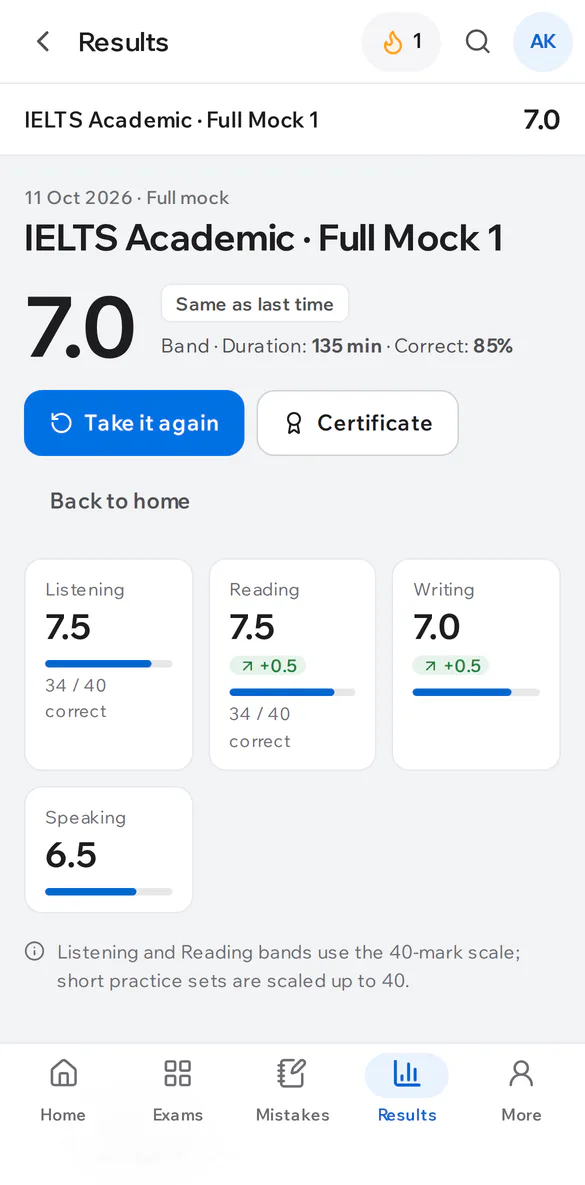
If you are preparing for IELTS in Tashkent, you usually have two options: sit a mock at a learning centre or take one online at home. Neither is the real IELTS - an official result only comes from the exam itself. The difference lies elsewhere: which one reproduces exam conditions better, which one you can take often, and which one shows your mistakes more clearly. Below is an honest comparison and a plan for using both. How to convert a mock result to a band and review it is covered in a separate article: /articles/ielts-mock-test-how-to-use.
First: how IELTS is delivered now
A mock helps only if it resembles your exam, so start with the format. According to ielts.org:
- Listening (about 30 minutes, 4 parts) and Reading (60 minutes, 3 parts) are taken on computer.
- Writing (60 minutes, 2 tasks) is typed. From mid-2026 some countries offer “Writing on Paper”: the tasks are on screen and you handwrite your answers on an answer sheet.
- Speaking is a face-to-face interview with an examiner, 11-14 minutes, 3 parts. It is recorded.
- So at least the Listening and Reading parts of your mock should be on screen. Check which option is offered in Tashkent on the official test provider’s page (British Council or IDP) before you book.
Online mock vs a mock at a centre
| Online mock | Mock at a centre | |
|---|---|---|
| Timing | The timer runs itself, but you create the quiet, phone-free room | An invigilator and other candidates - pressure close to exam day |
| Format | On screen, like computer-delivered IELTS | Depends on the centre: sometimes on paper, so ask first |
| Speaking | Microphone and an estimated AI score, no live partner | A conversation with a live person; the score depends on who marks it |
| Listening and Reading result | Instant, with every question explained | Depends on the centre: both the wait and the level of detail |
| Travel and cost | From home; there is a free plan | A fee for each attempt and travel time across the city |
| Repeats | Any day, plus separate section tests | When the centre schedules one, so less often |
What an online mock does well, and where it falls short
- Strength: you can take it often. Your level shows in the trend across several mocks, not in one score.
- Strength: the result is instant and every question is explained, so you see why you lost a mark the same day, not a week later.
- Strength: on a day without 2.5 free hours you can work on your weak part only, such as one Reading passage.
- Weakness: the discipline is yours. Pause the audio or check a dictionary and the band comes out higher than your real level.
- Weakness: there is no live person in Speaking. An AI score is good at showing your weakest criterion, but it cannot recreate the nerves of talking to a stranger.
What a centre mock does well, and 4 questions before you pay
The main value of a centre mock is a live Speaking test and exam-day pressure: an early start, the journey, an unfamiliar room, 2.5 hours in a row. That is hard to recreate at home. You will sit one rarely, though, so get the most from it. Ask before you sign up:
- Who marks Writing and Speaking, and do you get a separate score for each of the four official criteria?
- Is it a new test, or taken from published books you may already have done? A familiar test inflates your band.
- Are Listening and Reading on screen or on paper? If your exam is on computer, a paper mock will not get you used to the interface.
- When and in what form do you get the result: a band only, or a review of your mistakes?
The official free familiarisation test
IDP offers a free familiarisation test for IELTS on computer. It has Listening, Academic Reading and Academic Writing, it is untimed, you check your own answers, and it has no Speaking. IDP presents it as a way to get to know the test screens.
So it will not give you a band, but it is a good way to try the interface once before the exam: highlighting, moving between questions, the word count. IDP also advises Writing on Paper candidates to practise Writing by hand on paper.
Using both: a practical plan
- Start with one full online mock: your baseline band and your weakest skill. Work out the overall on /ielts/band-calculator.
- Then a full mock every 2 weeks, with section tests on your weak skill in between. Questions you miss go into your mistake notebook and come back for review.
- Practise Speaking every week with a microphone (/ielts/speaking) and, when you can, live with a friend or teacher. Sample questions: /articles/ielts-speaking-part-3-questions.
- A few weeks before the exam, one mock at a centre, mainly for live Speaking and exam-day pressure. It is optional: the trend across your online mocks already shows your level.
- Trylab’s free plan gives 1 mock and 2 section tests a month plus 10 questions a day. Every question is explained and the score is on the IELTS scale. AI scores Writing and Speaking on the Pro plan, and the free plan includes 1 AI score. You sign in through the Telegram bot.