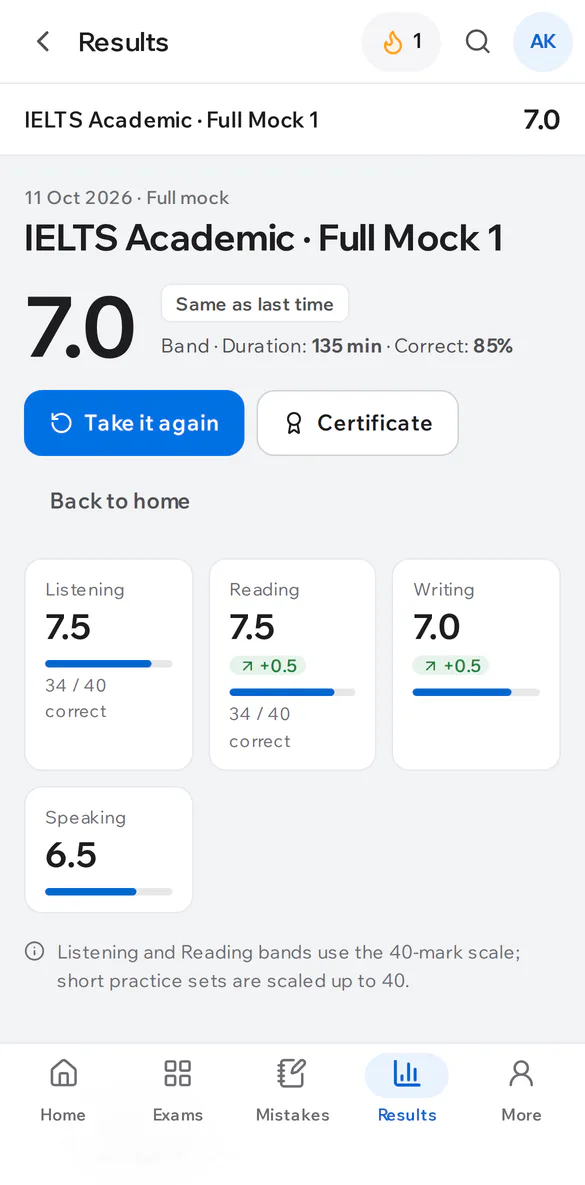
IELTS 7.0 takes about 30 correct answers out of 40 in Listening and Reading, plus band 7 performance in Writing and Speaking: a clear overview, well-developed arguments, fluent speech and precise vocabulary. This plan assumes 12 weeks from around 6.0, or the last 8 weeks if you start at 6.5, with 1.5-2 hours of work a day; everyone moves at a different pace, so adjust it after the mid-point mock. Below: a week-by-week plan, a daily routine and how to track progress.
What band 7 means
Overall 7.0 is the average of four bands rounded to the nearest half: for example 7.0 / 7.5 / 6.5 / 6.5 = 6.875 → 7.0. You do not need 7 in every skill, but one weak skill pulls the whole result down.
| Skill | For band 7 | Source |
|---|---|---|
| Listening | ~30 correct of 40 | ielts.org average threshold |
| Academic Reading | ~30 correct of 40 | ielts.org average threshold |
| Writing | A clear overview in Task 1, a clear position with developed ideas in Task 2, frequent error-free sentences | Band descriptors, May 2023 |
| Speaking | Long turns without noticeable effort, some idiomatic vocabulary, effective paraphrase | Band descriptors |
Week 0: your starting point
- Take a full timed mock: Listening, Reading, Writing, Speaking. That is your real level.
- Write down each band and the gap to your target.
- Give the biggest share of daily time to the weakest skill - usually Writing or Speaking.
- Pick a test date on an official site (ielts.org, British Council or IDP) and fit the plan to it.
The 12-week plan (6.0 to 7.0)
| Weeks | Main goal | What you do |
|---|---|---|
| 1-2 | Format and question types | Drill each Listening and Reading question type separately; learn the Task 1 and Task 2 structures; extend Part 1 answers |
| 3-4 | Weak question types | True/False/Not Given, matching headings, map labelling; 2 Task 2 essays a week; a Part 2 cue card every day |
| 5-6 | Vocabulary and paraphrase | Topic collocations; every Task 1 type (graph, table, process, map); supporting opinions in Part 3 |
| End of 6 | Mid-point mock | A full mock, compare with week 0, adjust the plan |
| 7-8 | Speed and timing | Reading in 60 minutes, Writing in 60 minutes; 3 essays a week; record Speaking and listen back |
| 9-10 | Band 7 criteria | Overview and argument development in Writing; accurate complex sentences; focus on Listening Parts 3-4 |
| 11 | Exam conditions | 2 full mocks a week, review the mistake notebook |
| 12 | Light week | One mock, review, sleep and rest; no new material |
A daily routine (1.5-2 hours)
| Time | Task |
|---|---|
| 20 minutes | Listening: one part + review with the transcript |
| 25 minutes | Reading: one timed passage + why each mistake happened |
| 30-40 minutes | Writing: Task 1 one day, Task 2 the next (or a plan and introduction) |
| 15 minutes | Speaking: 1 cue card + 3 Part 3 questions, recorded |
| 10 minutes | Vocabulary: new chunks and review |
Skill-by-skill tips
- Listening: one way to reach 30 is almost no mistakes in Parts 1-2 (18-19 correct) and 5-6 out of 10 in each of Parts 3-4. Cut spelling and word-limit errors to zero.
- Reading: no more than 20 minutes per passage. For every mistake, find the sentence that proves the answer and note why you missed it.
- Writing: Task 2 counts double, so most practice time goes to essays. Get each essay scored by criterion and work on the weakest one.
- Speaking: never stop at “yes/no” - add a reason and an example; speaking for the full 2 minutes in Part 2 should become a habit.
How to track progress
- A full mock every 2 weeks: keep a table (date, L, R, W, S, overall).
- A mistake notebook: group Listening/Reading errors by type (synonym, spelling, TFNG, timing) and see which type is not shrinking.
- In Writing, record the score for each criterion - you need to know which one is low, not just the band.
- If 2 mocks in a row are below target, consider moving the date - check the rescheduling rules on your test provider’s official site.
Common preparation mistakes
- Doing tests without reviewing them - the same mistake keeps coming back.
- Leaving Writing and Speaking to the last week: these skills grow slowest.
- Memorised ready-made answers: examiners notice and the score drops.
- 2-3 mocks the day before the exam: fatigue lowers the result.
Frequently asked questions
- Can I go from 6.0 to 7.0 in one month? There is no guarantee: it depends on your start level, your time and your weakest skill. Decide after the mid-point mock.
- Do I need 7 in every skill? Not for the overall - an average of 6.75 rounds to 7.0. But a university or organisation may set a minimum per skill, so check its requirements.
- Do I need a course, or is self-study enough? Both can work; what matters is regular scoring and feedback on Writing and Speaking.
- How much time a day? This plan assumes 1.5-2 hours; with less time, stretch the plan.