IELTS Listening takes about 30 minutes: 4 parts of 10 questions, and each recording is played only once (ielts.org). Each part has its own situation, so marks are lost for different reasons: numbers and corrections in Part 1, the map and the long list in Part 2, whose opinion it is in Part 3, and paraphrase in the Part 4 lecture. Below: each part, its main trap and how to practise against it. The general format and question types are in a separate article: /en/articles/ielts-listening-tips.
Part 1: two people talking - numbers, letters and corrections
ielts.org: Part 1 is a conversation between two speakers in an everyday situation, for example about travel arrangements. Facts come up - a name, a date, a price, an address - and they usually go into a form or a table.
| Trap | Example | What to do |
|---|---|---|
| The speaker corrects themselves | “On the 13th... no, sorry, the 30th” | Write the final, confirmed version |
| A name is spelled out | “That’s K-E-R-R, double R” | Drill the English alphabet by ear, especially A/E/I, G/J and “double” |
| Similar numbers | “fifteen” vs “fifty”, a phone number | Listen for the stress; write numbers as figures |
| Two prices or two dates | “The double is 80, but the single is 65” | Use the key word to know beforehand which one the question asks for |
Part 2: one speaker - the map and the long list
ielts.org: Part 2 has one main speaker on an everyday topic, for example a talk about local facilities. You may meet a plan of a building or a map of part of a town, and choosing several answers from a longer list.
| Trap | Example | What to do |
|---|---|---|
| Losing the starting point | “As you come in through the main entrance...” | Before the audio starts, find the entrance on the map and keep a finger on it |
| Direction words | “straight on”, “through the far door”, “opposite”, “just past” | Keep these phrases in a separate list and say them aloud |
| Everything gets mentioned | The talk names 5 activities, the question asks only about the free ones | Underline the condition in the question (free, new, closed) |
| How many answers | “Choose TWO letters” | ielts.org: sometimes you choose more than one answer from a longer list - check how many |
Part 3: a discussion - whose opinion and the final decision
ielts.org: Part 3 is a conversation between two main speakers in an educational setting, for example two students, perhaps guided by a tutor. The official description says matching tests exactly this: following a conversation between two people and seeing how facts connect.
| Trap | Example | What to do |
|---|---|---|
| Suggested, then rejected | A: “We could do a survey.” B: “That would take too long.” | Wait for the option both of them agree on |
| Whose opinion is asked | “What does the tutor think about...?” | Mark the speaker in the question and ignore the other person’s view |
| The opinion changes | “I wasn’t sure at first, but now I think...” | Write the final view |
| Agreement and doubt | “Exactly”, “Fair enough”, “I’m not so sure” | Learn these phrases in two columns: agree / disagree |
Part 4: a lecture - paraphrase and word form
ielts.org: in Part 4 one person speaks on an academic subject. Note or sentence completion may appear here: you write the word you hear and do not need to change it.
| Trap | Example | What to do |
|---|---|---|
| Different words in the notes | The sheet says “Main problem: ___ of the materials”, the audio says “the real difficulty was the weight of the materials” | Listen for a synonym of the words around the gap, not the words themselves |
| Part of speech | “the ___ of the bridge” needs a noun (strength), not an adjective | Mark next to each gap what it needs: noun, verb, number |
| Word limit | “ONE WORD ONLY”, and you wrote “the strength” | Going over the limit loses the mark (ielts.org); a hyphenated word counts as one |
| Losing your place | You missed one answer and the next three went too | Questions follow the order of the recording (ielts.org): if you miss one, move on; “moving on to” and “finally” signal a new section |
Practising part by part, and tests on Trylab
- After a full test, write down your score for each part: how many out of 10. The weakest part is next week’s goal. Band 7 needs about 30 out of 40 (ielts.org), which means 10 errors in total.
- Drill the weak part on its own: name and number dictation for Part 1, maps and directions for Part 2, agreement phrases for Part 3, lecture notes for Part 4.
- Replay the section you got wrong with the transcript and label the trap: a correction, a condition, whose opinion, or a paraphrase.
- The recordings use British, Australian, New Zealand and North American accents (ielts.org) - practise with all of them.
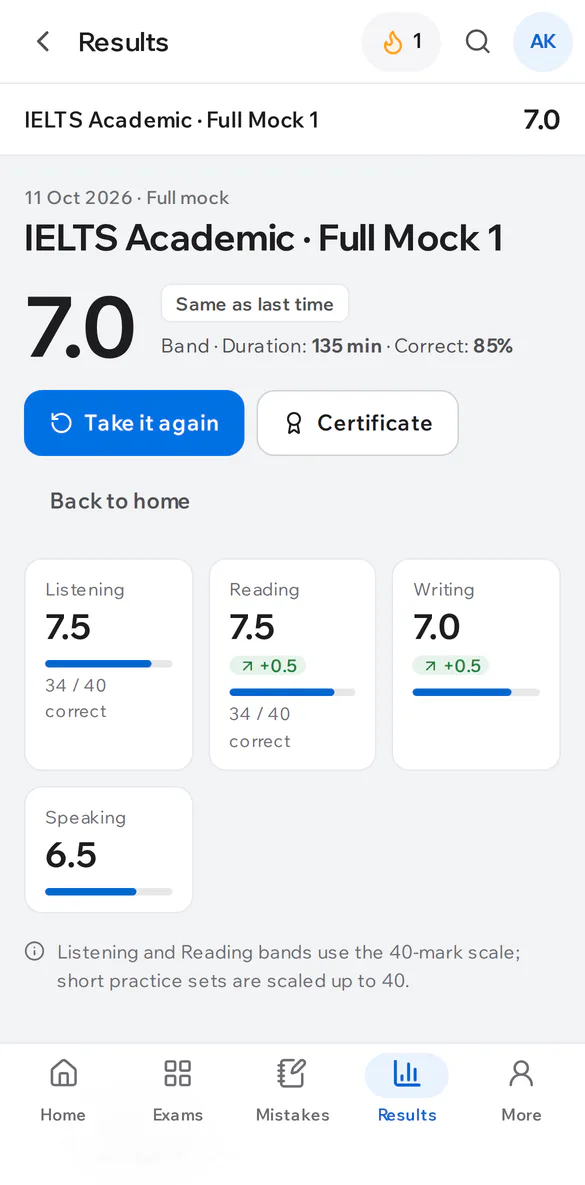
- On Trylab, /en/ielts/listening has Listening tests in the real format: audio played once, an instant band score, an explanation for every question, and missed questions saved to your mistake notebook.
- The free plan gives 1 mock and 2 section tests a month plus 10 questions a day; you sign in through the Telegram bot.
Frequently asked questions
- How many questions are in each part? 10, so 40 in total.
- Is the audio replayed? No, you hear it once only.
- Do the questions follow the order of the recording? Yes: the answer to question 1 comes before the answer to question 2.
- How many correct answers does band 7 need? About 30 out of 40; the exact threshold varies slightly between test versions.