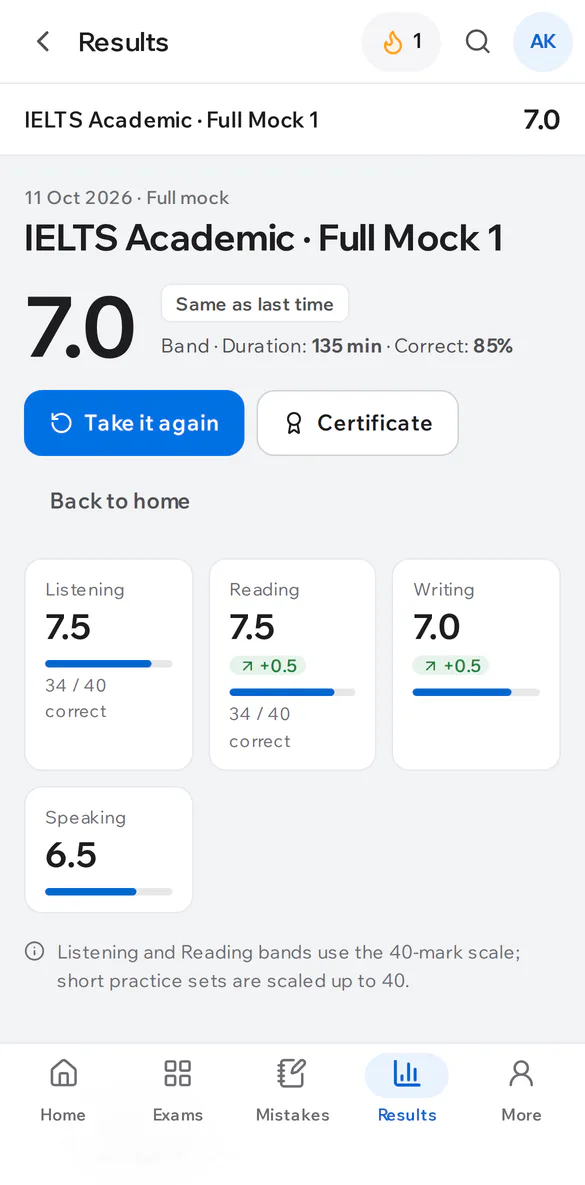
IELTS results are given in bands from 0 to 9: a separate band for each skill and one overall band. The overall band is the average of the four skills, rounded to the nearest half band. Knowing how it is worked out helps you plan your target score.
How the overall band is worked out
The overall band is the average of your four skill bands, rounded to the nearest half band. An average ending in .25 goes up to the half band above (.5), and one ending in .75 goes up to the next whole band.
| Bands (L / R / W / S) | Average | Overall |
|---|---|---|
| 6.5 / 6.5 / 5.5 / 6.0 | 6.125 | 6.0 |
| 6.5 / 6.5 / 6.0 / 6.0 | 6.25 | 6.5 |
| 7.0 / 7.0 / 6.5 / 6.5 | 6.75 | 7.0 |
Listening and Reading
Each has 40 questions, and each correct answer is 1 raw point. The raw score is converted to a band with an official table that differs slightly from test to test. Roughly: 30/40 in Listening is around 7.0, and 30/40 in Academic Reading is around 7.0.
Writing and Speaking
- Writing is marked on four criteria: Task Response, Coherence and Cohesion, Lexical Resource, Grammatical Range and Accuracy.
- Task 2 counts twice as much as Task 1, so a strong essay lifts your Writing band the most.
- Speaking is also marked on four criteria: Fluency and Coherence, Lexical Resource, Grammatical Range and Accuracy, Pronunciation.