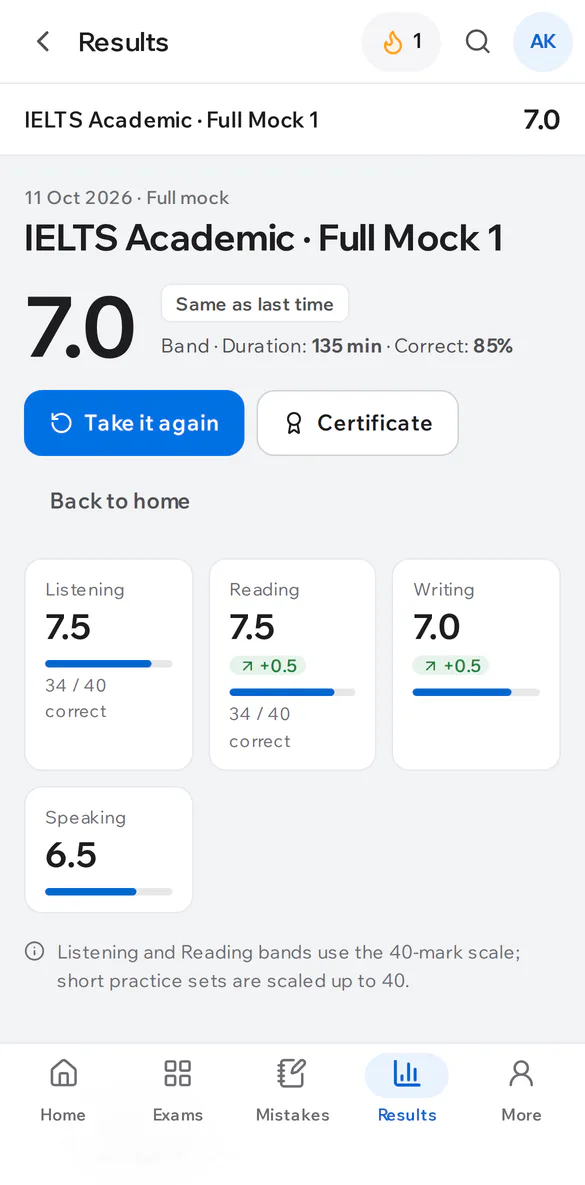
An IELTS mock test does more than answer “what will I get?” - it shows which skill and which question type cost you marks. Correct answers in Listening and Reading convert to a band on a scale close to the official one (for example, 30 out of 40 ≈ 7.0), and the overall band is the average of the four bands rounded to the nearest half. Below: how to sit a mock, how to score it and how to review it.
Sit the mock like the real exam
- Keep strict time: Listening ~30 minutes, Reading 60 minutes, Writing 60 minutes. Reading has no extra transfer time.
- Do not pause or replay the Listening audio - in the exam it is played once.
- No dictionary, phone or translator - otherwise the band comes out higher than your real level.
- If you can, do Listening, Reading and Writing in one sitting in exam order: fatigue is part of the exam too.
- If you will sit the computer test, take the mock on screen as well.
Listening and Reading: raw score → band
Each correct answer is 1 mark out of 40. Average thresholds from ielts.org (they vary slightly by test):
| Band | Listening | Academic Reading | General Training Reading |
|---|---|---|---|
| 4 | - | - | 15 |
| 5 | 16 | 15 | 23 |
| 6 | 23 | 23 | 30 |
| 7 | 30 | 30 | 35 |
| 8 | 35 | 35 | - |
- For the in-between bands Trylab uses the widely published Academic table: for example 26 correct in Listening ≈ 6.5 and 32 ≈ 7.5; 27 in Reading ≈ 6.5 and 33 ≈ 7.5.
How to score Writing and Speaking
- Writing has four equally weighted criteria: Task Achievement / Task Response, Coherence and Cohesion, Lexical Resource, Grammatical Range and Accuracy. Task 2 carries twice the weight of Task 1.
- Speaking also has four: Fluency and Coherence, Lexical Resource, Grammatical Range and Accuracy, Pronunciation.
- Self-marking is hard: compare with the official band descriptors or use an AI score. It is an estimate and is most useful for showing your weakest criterion.
- Check length: Task 1 needs at least 150 words, Task 2 at least 250. A short answer cannot reach a high band.
How the overall band is calculated
Overall is the average of the four bands, rounded to the nearest half band. An average ending in .25 rounds up to the next half band, one ending in .75 to the next whole band. Examples from ielts.org:
| L / R / W / S | Average | Overall |
|---|---|---|
| 6.5 / 6.5 / 5.0 / 7.0 | 6.25 | 6.5 |
| 4.0 / 3.5 / 4.0 / 4.0 | 3.875 | 4.0 |
| 6.5 / 6.5 / 5.5 / 6.0 | 6.125 | 6.0 |
Reviewing your result: 4 questions
- Which skill is lowest? Your weakest skill raises the overall fastest, because it pulls the average down most.
- Which question type has the most errors? If you missed 3 of 6 TFNG items, that type is next week’s focus.
- Why did the error happen? Missing knowledge, running out of time or carelessness (spelling, word limit) - each needs a different fix.
- Which Writing criterion is low? Look past the band to the criterion: low Task Response means you did not fully answer the question, low Lexical Resource means word choice.
Error types and what to do
| Error type | Sign | Fix |
|---|---|---|
| Missed synonym | The answer was in the audio/text, in other words | Keep a list of paraphrase pairs |
| Spelling / word limit | Right idea, no mark | Count these after every mock and get them to zero |
| Timing | Last text or questions left undone | A time limit per passage, skip hard questions |
| Distractor | The speaker corrected themselves, you wrote the first version | Listen for the final version |
| Question type | Always wrong on the same type | Drill that type on its own |
How often to take a mock
- A full mock every day is pointless: no time is left for review and practice.
- At the start, one full mock as a baseline, then one every 2 weeks.
- In the last 2-3 weeks, 1-2 a week under exam conditions.
- Retaking the same mock inflates your band: you remember the answers. A new version shows your real level.
- Between mocks, do section tests: just Listening or one Reading passage, targeted at your weak spot.
How mocks work on Trylab
- IELTS mock tests in the real format: Listening audio played once, Reading in 60 minutes.
- An instant result on the band scale: each skill and overall.
- An explanation for every question: why the answer is right and where it is in the text.
- Writing and Speaking scored by AI on the four official criteria.
- Missed questions go into your mistake notebook and come back for review.
Frequently asked questions
- How close is a mock result to the real IELTS? Listening and Reading bands use a table close to the official thresholds - a reliable guide. Writing and Speaking scores are estimates.
- Can I take the same mock twice? You can, but the second result will not show your level - you remember the answers.
- What band is 29 correct in Listening? 6.5 on Trylab’s table: 7.0 starts at 30 correct.
- What if my overall average is 6.75? It rounds up to 7.0.