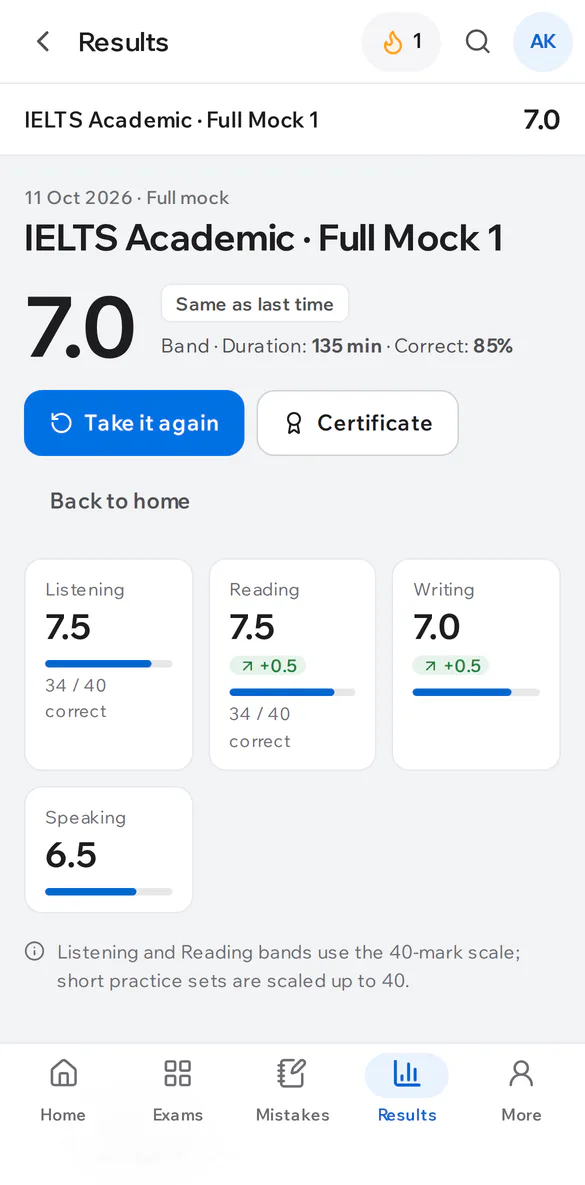
With 30 days to go, starting a new textbook rarely pays off: this month the points come from getting used to the format, closing 3-4 weak topics and working through your mistakes. The structure that works: week 1 diagnosis and a mistake list, week 2 weak topics and open tasks, week 3 mock tests under real timing, week 4 review and rest. Below are a daily routine for each week, timings for each subject and an exam-day checklist.
The 30 days at a glance
A mock test is a full paper with the same time and structure as the exam: 150 minutes for maths, physics, chemistry, biology and geography, 120 + 60 for native language, 90 for history.
| Week | Main goal | Mock test | Per day |
|---|---|---|---|
| 1 (days 1-7) | Starting score and mistake list | 1 full, real timing | 2-3 hours |
| 2 (days 8-14) | The 3-4 topics that cost the most | 1 full | 2-3 hours |
| 3 (days 15-21) | Real format, timing, open tasks | 2 full | 3 hours |
| 4 (days 22-30) | Review, mistake notebook, rest | 1, 5-7 days before the exam | 1.5-2 hours |
Week 1: where you are
- Day 1: sit a full paper under real timing, phone away, in one go.
- Day 2: review every mistake and log it: topic, task number, mistake type (didn't know, calculation slip, misread the condition, ran out of time).
- Days 3-7: group the mistakes by topic and count which topic costs the most points. Tasks are worth 1.3, 2.2 and 3.2, so one 3.2 mistake costs more than two 1.3 ones.
- At the end of the week write down the gap «target - current»: for example B+ needs 60, you have 52, so you need 8 more points.
Week 2: weak topics
- One weak topic a day: 30-40 minutes of theory, 60-90 minutes of problems on it.
- Give the open a/b tasks their own time: they carry a large share of the score (32 points in maths and the sciences).
- Midweek, redo your mistake notebook for the first time: it tests real understanding.
- Day 7: one full mock - did the weak topics improve?
Week 3: real format and timing
- Two full mocks at the same time of day as the exam: a morning exam means a morning mock.
- The day after each mock is for review only. Review takes as long as the paper did.
- Test your timing plan: note how many minutes go to the MCQs, the open part and checking.
- Native language: write the essay in 60 minutes in every mock - introduction, a body of at least three paragraphs, conclusion.
Week 4: review and rest
- Start no new topics. Only the mistake notebook, formulas, dates and rules.
- Sit the last full mock 5-7 days before the exam, leaving time to review it and settle down.
- Last 2-3 days: light review, 20-30 easy and medium tasks, a sleep routine.
- The day before: close the books, prepare your documents, go to bed early.
A sample day (weeks 2-3)
On a mock day the full paper replaces this, and the next day is the review.
| Time | Task |
|---|---|
| 30 minutes | Redo yesterday's mistakes |
| 60 minutes | Weak topic: theory and 10-15 problems |
| 10 minutes | Break |
| 45 minutes | Open a/b tasks or text work |
| 15 minutes | Log today's mistakes |
Exam-day checklist
- Check the documents, the admission pass and the list of allowed items on the official website (uzbmb.uz) in advance.
- Arrive at the venue early.
- Skim all the tasks first and stick to your timing plan.
- Wrong answers lose nothing - leave no task blank at the end.
- In open tasks always write a), even if you do not know b).
If you have less than 30 days
- 14 days: week 1 diagnosis and 2-3 weak topics, week 2 two mocks and review.
- 7 days: 1 mock, 2 days of review, 3 days on the 1-2 topics with the most mistakes, the last day off.
- With more time, follow the 8-week plan and switch to this one for the final month.
FAQ
- Can you prepare for the Milliy sertifikat in a month? If you know the subject basics from school, yes: this month getting used to the format and closing weak topics earns more than new material. Starting from zero, 30 days is usually not enough.
- How many hours a day? The 2-3 hours in the plan are enough when the work is focused. Short regular sessions beat long scattered ones.
- What if you take several subjects? Keep separate mocks and mistake lists for each and alternate mock days between subjects.
- Should you try new papers in the last days? In the final 2-3 days light review and sleep matter more than a full paper.