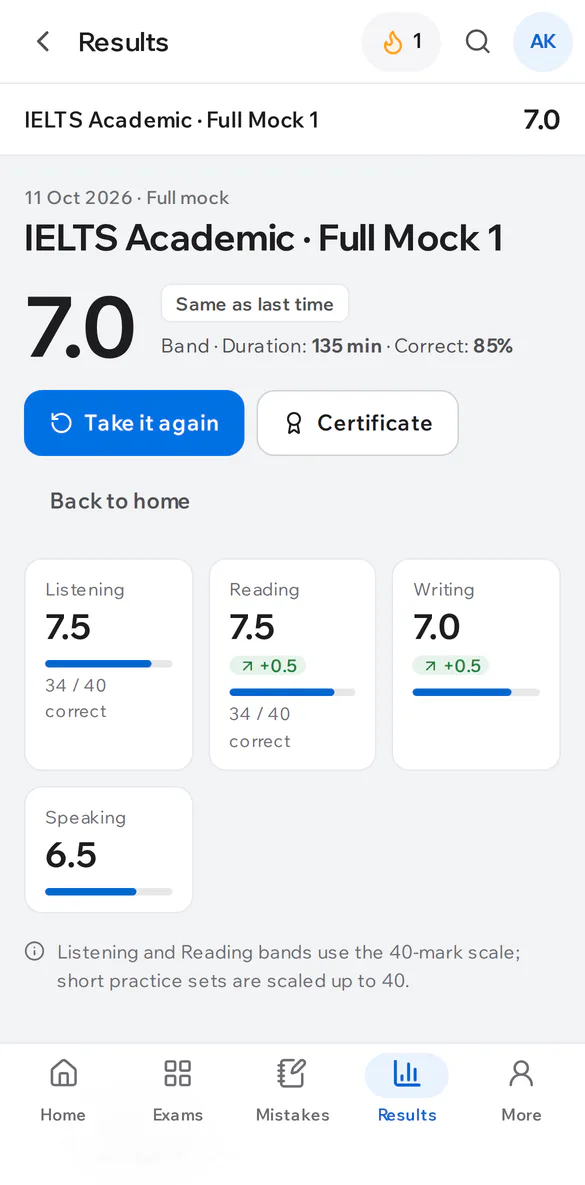
In the Milliy sertifikat most lost points come not from missing knowledge but from format mistakes: leaving tasks blank, writing only one part of an open a/b task, finding something other than what was asked, spending the time on one hard question. Below are the mistakes common to every subject, then the most frequent ones in each - maths, physics, chemistry, biology, native language, history, geography and English - and how to get rid of them.
Mistakes common to every subject
- Leaving a task blank. Wrong answers lose nothing, a blank answer is a sure 0.
- Wrestling with b) in an open task and never writing a). The parts are marked separately: a) alone is worth 1.5 points (1.1 in some history and geography tasks).
- Expecting easy-to-hard order. In the official samples easy and medium tasks are mixed, so a hard task 3 is normal.
- Getting stuck on one question. Ten minutes on one 2.2-point task leaves no time for 3-4 easy ones at the end.
- Ignoring task values. A 3.2-point task is worth more than two 1.3-point ones - take them first on the second pass.
Reading-the-question mistakes
- Giving the largest when the smallest is asked, the product instead of the sum.
- Choosing the correct option in a «find the wrong answer» question - underline words like «wrong» and «does not match».
- Missing the unit: cm and m, grams and kilograms, minutes and hours.
- Answering an «according to the text» question from your own knowledge instead of the text.
Maths and physics
- Not checking the domain: positive under a logarithm, non-negative under a root, a denominator never zero.
- Forgetting the endpoints when finding the maximum or minimum on an interval.
- Rounding an intermediate result too early - the final answer moves.
- In physics not converting to SI: km/h to m/s (36 km/h = 10 m/s), cm to m, grams to kg.
- In physics forgetting vector directions: the signs of velocity, force and acceleration.
Chemistry and biology
- In chemistry calculating from an unbalanced equation: wrong coefficient ratios make the whole problem wrong.
- Mixing up the mass of the solution and of the solvent: 20 g salt + 180 g water = 200 g solution, mass fraction 10%, not 11.1%.
- Getting the molar mass wrong: forgetting the water in a crystal hydrate (MgSO₄·7H₂O).
- In biology forgetting that DNA has A = T and G = C; an A-T pair has 2 hydrogen bonds, a G-C pair 3.
- In genetics mixing ratios and percentages: in a 3 : 1 split the recessive trait is 25%.
Native language and literature
- Rushing words in spelling tasks: the options differ by one letter.
- In a written answer (36-44) giving two options or misspelling the word - it may not be accepted.
- Naming a part of speech when a sentence member is asked: «ot» (noun) instead of «töldiruvçi» (object).
- Adding a plan or an epigraph to the essay - the official rules say they are not written. The essay has an introduction, a body of at least three paragraphs and a conclusion.
- Opening the essay by copying the situation text word for word.
History
- Swapping two neighbouring events in a chronology - that is exactly how the options are built. Write the year next to each event, then order them.
- Reversing BC dates: 509 BC comes before 490 BC.
- Getting the century wrong: 1500 is the 15th century, 1501 the 16th.
- In a source task, spotting one key clue and not checking the rest: a statement about a ruler may belong to another era.
Geography and English
- Calculating an area with the linear scale: convert the sides to km first, then multiply.
- Mixing up the direction of a time difference: further east is ahead, 15° = 1 hour.
- Not subtracting the starting height in temperature and pressure problems.
- In English (Multilevel) Writing ignoring the word count and mixing styles: formal phrases in an informal letter, contractions in a formal one.
- In Reading adding what the text does not say.
How to get rid of them
- After each mock sort your mistakes by type: didn't know, calculation, misreading, time.
- For format mistakes (blank answers, only b), units) keep a short checklist and look at it before every mock.
- Redo wrong tasks after 1, 3 and 7 days.
- In the last 2-3 weeks sit mocks under real timing: time mistakes only show up that way.
FAQ
- Are points deducted for wrong answers? No. So mark an answer to every task, even in the last minutes.
- Do you score if only a) of an open task is right? Yes, a) and b) are marked separately.
- Which mistake costs the most? Usually blank tasks and the last open tasks left for lack of time: they take several points at once.
- How do I find my mistakes quickly? Sit a mock in the real format and tag each mistake by type - the main type shows after a single mock.