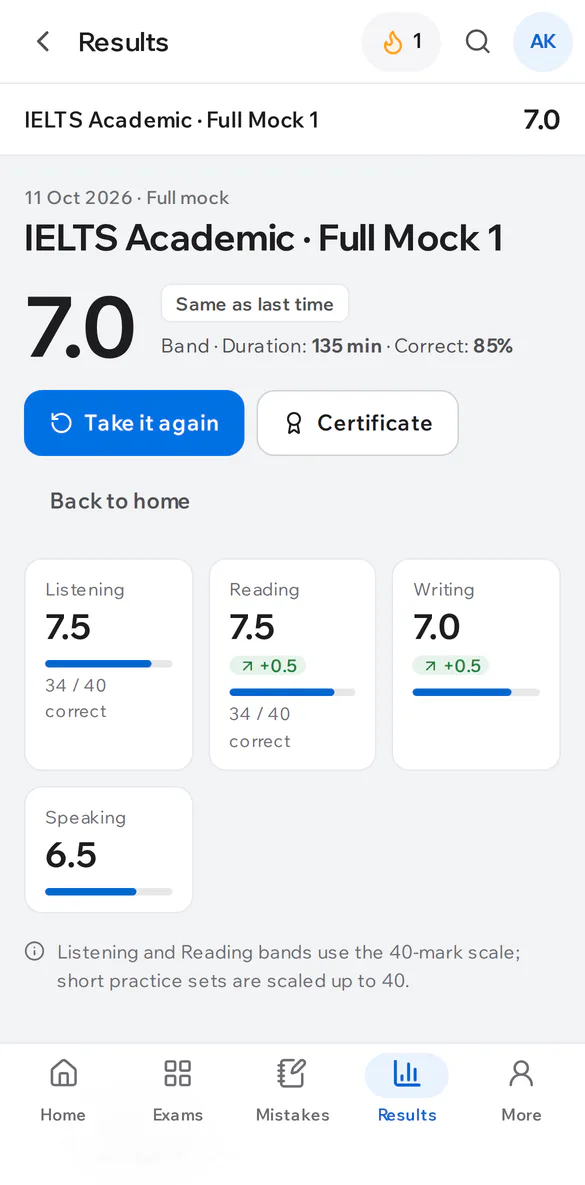
Both exams test the same four skills: Listening, Reading, Writing and Speaking. They answer different questions, though. Multilevel is run in Uzbekistan by the Agency for Assessment of Knowledge and Skills (uzbmb.uz), and its result is a national certificate in a foreign language at level B1, B2 or C1. IELTS is an international exam scored on a 0-9 band scale. Which one you need depends on where you are sending your documents, not on the exam itself. The comparison below uses only what the official pages state.
At a glance
It is called multilevel because one exam measures several levels: you do not register for a B2 test, your result places you at B1, B2 or C1.
| Multilevel | IELTS | |
|---|---|---|
| Run by | Agency for Assessment of Knowledge and Skills (uzbmb.uz) | IELTS partners (British Council, IDP) |
| Result | Each section out of 75, level B1, B2 or C1 | Each section and overall on a 0-9 band scale |
| Sections | Listening, Reading, Writing, Speaking | Listening, Reading, Writing, Speaking |
| Languages | English, German, French, Arabic, Turkish | English only |
| Versions | One test covering B1 to C1 | Academic and General Training |
Scales: a CEFR level is not a band
The Agency's assessment criteria set the Multilevel levels on a 75-point scale. IELTS uses 9 bands: the overall band is the average of the four sections rounded to the nearest half band (6.25 becomes 6.5, 6.75 becomes 7.0).
| Multilevel level | Points (out of 75) |
|---|---|
| C1 | 65 - 75 |
| B2 | 51 - 64 |
| B1 | 38 - 50 |
| Below B1 | 0 - 37 |
- ielts.org says IELTS is not a level-based test and has no one-to-one match with the CEFR: band 8.5 and above is recognised as C2, and the C1 threshold falls between bands 6.5 and 7.0.
- There is no official table that converts a Multilevel result into an IELTS band. Ignore rules like "C1 = 7.0": the organisation you apply to states which test and which result it wants.
- Multilevel has no C2: the highest result is C1. IELTS goes up to band 9.
Where each result is used
A Multilevel result is a national certificate in a foreign language. It is used where Uzbekistan's rules ask for a national certificate, for example in university admission rules. How many points each level gives and for which programmes it counts are published in each year's admission rules, so check the current rules and your university's requirements.
We found no official general statement on whether universities abroad accept Multilevel. If you are applying abroad, ask the university.
According to ielts.org, IELTS is accepted by thousands of universities, employers, professional bodies and government agencies. ielts.org has a "Who accepts IELTS" search by organisation name and country. Each organisation sets the band it needs. ielts.org recommends treating results as valid for two years after the test, but check that with the organisation too.
How to choose: 4 situations
- You are applying to a university in Uzbekistan and its admission rules list a national certificate in a foreign language: take Multilevel, and check how each level counts in this year's rules.
- You are applying abroad: open the "English language requirements" page of the university. It usually lists the accepted tests and the band. Bachelor's and master's programmes usually ask for IELTS Academic; we explain how it differs from General Training in /en/articles/ielts-academic-vs-general.
- You need German, French, Arabic or Turkish rather than English: Multilevel exists in these languages, IELTS is English only.
- You need both: most of the preparation is shared, since the skills are the same. The task types differ, so take at least one full mock in each exam's own format.
Preparation: what is shared and what is not
- Shared: vocabulary, accurate grammar, fast reading and listening comprehension. Practice for one exam helps with the other.
- Different: task types and timing. IELTS Listening takes about 30 minutes (4 parts, 40 questions), Reading 60 minutes (40 questions), Writing 60 minutes (2 tasks) and Speaking 11-14 minutes. For the Multilevel structure, read /en/articles/multilevel-exam-format.
- Keep the Writing rules apart: IELTS Task 2 needs at least 250 words, while each Multilevel task has its own word count.
- Track your result on the exam's own scale: points out of 75 and a level for Multilevel, bands for IELTS. You can work out a band at /en/ielts/band-calculator.
Preparing for both on Trylab
/en/multilevel has Reading and Writing in the Multilevel format, scored out of 75 with an estimated CEFR level. Listening and Speaking are not there yet. /en/ielts has IELTS mocks with all four sections, scored in bands. Every question is explained and your mistakes go into a mistake notebook.
The free plan gives you 1 mock and 2 section tests a month plus 10 questions a day. AI scores Writing and Speaking on the Pro plan; the free plan includes 1 AI score. You sign in through the Telegram bot.