A mock test pays off in the review, not the score. For any exam - SAT, IELTS, the National Certificate, DTM or Multilevel - the review is the same 4 steps: compare your score with your target section by section, sort every mistake by type (knowledge, careless, time, guessed), log the mistakes and re-solve them at spaced intervals, and take the next mock at the right time. Here is each step with examples.
Step 1: your score versus your target
The total on its own tells you little. Work out the gap for each section: the one furthest from target is your main job for the next 1-2 weeks. Example with an SAT target of 1400:
| Section | Mock | Target | Gap |
|---|---|---|---|
| Reading and Writing | 620 | 700 | -80 |
| Math | 640 | 700 | -60 |
| Total | 1260 | 1400 | -140 |
- The same goes for IELTS: look past the overall to each of the four skills. The weakest one drags the average down the most.
- One mock is one data point. Compare it with the previous mock taken under the same conditions and look at the trend over 2-3 mocks: a 10-20 point swing can be noise.
Step 2: sort every mistake by type
Next to every wrong or guessed question, write down why. Four types are enough:
| Type | Sign | What to do |
|---|---|---|
| Knowledge | You did not know the rule, formula or word | Relearn the topic and take a section test on it |
| Careless | You knew it but misread the question or slipped in a calculation | A checklist: reread the question, check units and signs |
| Time | You ran out of time or rushed the last questions | A time limit per question or passage, leave hard ones for later |
| Guessed | The answer was right but you were not sure | Count it as a mistake and treat it as a knowledge gap |
- Flag your guesses during the mock itself, or you will not be able to tell them apart later.
- Then count the types: if 9 of 20 mistakes are knowledge, 6 careless, 3 time and 2 guessed, topics are the main job, but the 6 careless ones are the quickest points to win back.
- Mistakes that repeat in one question type or topic are a signal of their own: drill that type in section tests.
Step 3: a mistake log and spaced re-solving
A mistake log is more than a list of right answers. Each entry needs:
- The exam, section and topic or question type.
- The error type (knowledge, careless, time, guessed) and the cause in one sentence.
- The right method: the rule, the formula or the key line in the text.
- The date of the next re-solve.
- Re-solve the question at spaced intervals without looking at the answer: for example after 1, 3 and 7 days. Right moves it to the next interval; wrong sends it back to the start.
- The next day you still remember the answer, so one review is not enough: the real test is getting it right a week later.
Step 4: when to take the next mock
- Do not start a new mock until every mistake from the last one is reviewed and your 2-3 most common error groups have been drilled in section tests.
- Early and mid-prep, one full mock every 1-2 weeks is usually enough; in the last 3-4 weeks before the exam, 1-2 a week.
- Always take a new version: retaking the same mock inflates the score because you remember the answers.
- Keep the conditions the same every time: full time, one sitting, no phone. Otherwise two scores cannot be compared.
- If your score has not moved in 2-3 mocks, do not add more mocks - change the method: more time on review and section tests.
How Trylab shows this
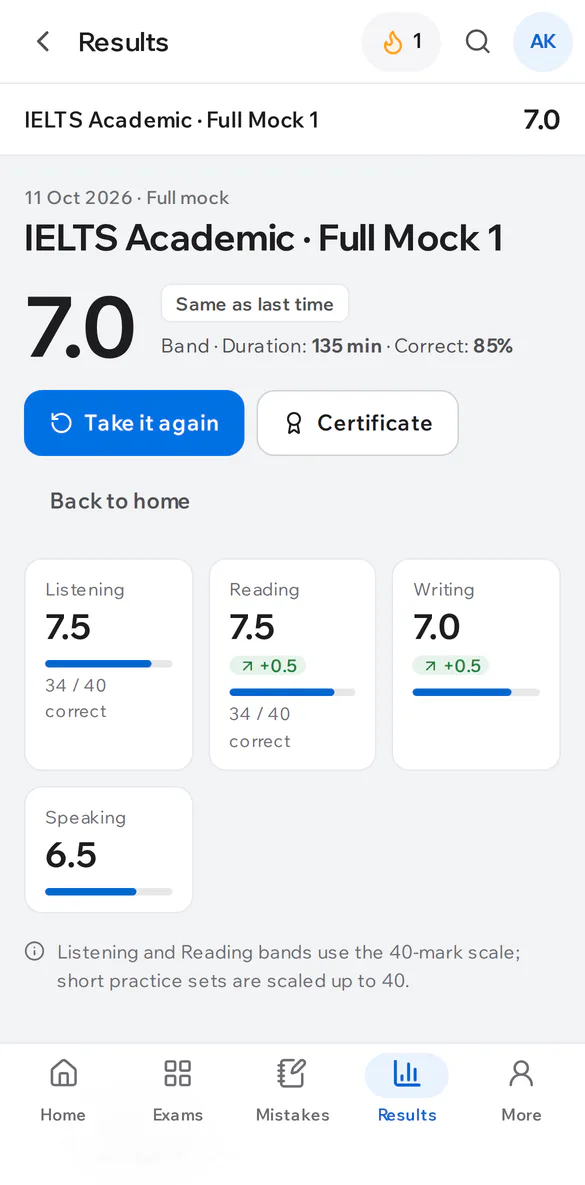
- The result page: the score on the exam’s own scale (SAT 400-1600, IELTS bands, National Certificate points and grade), each section on its own, and the number of right, wrong and unanswered questions.
- If you retake a test, each section shows the change since your previous attempt, and /app/results charts your score for each exam.
- The answer review: a “Mistakes only” filter, your answer, the right answer and the explanation, plus your result by question type, so the weak type stands out at once.
- Writing and Speaking are scored by AI on each official criterion separately (on the Pro plan; once on the free plan).
- The mistake notebook (/app/mistakes): missed questions go in automatically, sorted into folders by exam and section, and come back after 1, 3 and 7 days; miss one again and it starts over.
- Trylab cannot tell the error type (knowledge, careless, time, guessed) for you - mark it yourself during the review.
- The free plan gives 1 mock and 2 section tests a month, plus 10 questions a day. You sign in through the Telegram bot.
Frequently asked questions
- How long should the review take? Usually no less than the mock itself, so do not squeeze the mock and the review into one day.
- Should a lucky guess go in the log? Yes. It counted towards your score, but next time luck may not be on your side.
- My score dropped since the last mock - what now? First check the version’s difficulty and your conditions, then compare the error types. One low result is not a trend yet.
- Can I prepare by watching the score alone? The score shows where you are; the mistake review shows where to go next.