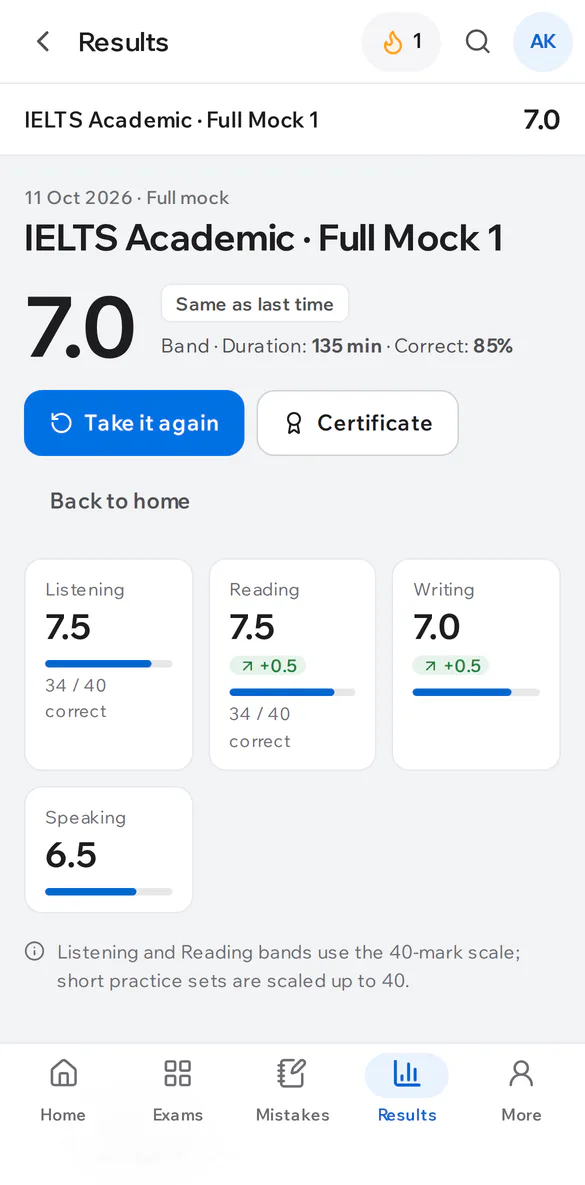
A mock test is a rehearsal: it shows where you lose marks and what exam day will feel like. But some habits push the result above or below your real level, and a mock without a review is wasted time. Below are 10 mistakes that show up the same way in IELTS, SAT, the Uzbek national certificate, DTM and other exams, each with one practical fix.
Condition mistakes: the score is not real (1-4)
These mistakes make a mock easier than the exam: the result looks good, then test day goes differently.
- 1. No timer. Without time pressure you reach every question; in the exam the last ones run out of time. Fix: set the official time and never stop the clock - for example SAT Reading and Writing 64 minutes, Math 70 minutes, IELTS Reading 60 minutes.
- 2. Pausing or replaying the audio. In IELTS Listening the recordings are heard once only. Fix: play the listening section straight through; guess any answer you missed and move on.
- 3. Checking answers mid-test. Looking at the key after each section changes your mood for the next one and hides the effect of fatigue. Fix: open the key only when the whole mock is over, and flag doubtful questions as you go.
- 4. Mocking on a phone when the exam looks different. Long passages, graphs and tables read differently on a small screen, and handwriting and typing run at different speeds. Fix: take the mock in the exam’s format - the SAT is taken on screen in the Bluebook app, IELTS on computer or on paper; prepare for a paper exam on paper. Keep the phone for short drills.
Review mistakes: the mock teaches nothing (5-7)
- 5. Not reviewing errors. Glancing at the score and moving to the next mock is the most common mistake of all. Fix: write a cause next to every wrong answer - missing knowledge, time or carelessness. Next week’s plan comes from that list.
- 6. Not tracking scores. One result says little; only the trend shows progress. Fix: after every mock, log the date, the total and each section score in one table and watch how each section moves.
- 7. Retaking the same version and trusting the score. The second time you remember the answers and the score is inflated. Fix: only a new version shows your level; treat a repeat as a review exercise.
Planning mistakes (8-10)
- 8. Taking mocks too often or too rarely. A full mock every day leaves no time for review and practice; only 1-2 mocks before the exam means meeting timing and fatigue for the first time on test day. Fix: one baseline mock at the start, then one every 2 weeks, and 1-2 a week in the last 2-3 weeks, with section tests on your weak area in between.
- 9. Skipping writing and speaking. The objective part is easy to mark, so it gets practised; the written and spoken parts are left out, though they are scored in the exam too. Fix: write IELTS Writing or the national certificate native-language essay under time and get it scored (a teacher, the official criteria or an AI score); record your Speaking answers and listen back.
- 10. Getting stuck on a hard question and leaving blanks. Five minutes on one question means the easy ones at the end go unanswered. Fix: set a time limit per question, flag the hard one, skip it and come back at the end. Where wrong answers cost nothing (the SAT, for example), leave nothing blank - check the rule for your own exam.
After the mock: a 5-step review
- Log the result: total and each section.
- Give every error a cause: knowledge, time or carelessness.
- Also review questions you got right by guessing - they are weak spots too.
- Pick the 1-2 topics or question types with the most errors - they get the next 2 weeks of practice.
- Copy wrong questions into a notebook and solve them again a few days later.
How mocks work on Trylab
- Mock tests in the real format: exam timing, IELTS Listening audio played once. Every exam: /en/mock-tests.
- The result is on the exam’s own scale, and every question has an explanation.
- Questions you miss go into your mistake notebook and come back for review.
- AI scores Writing and Speaking on the Pro plan; the free plan includes 1 AI score.
- The free plan gives 1 mock + 2 section tests a month and 10 questions a day - enough for a baseline and practice on your weak section. Sign-in is through the Telegram bot.
Frequently asked questions
- How many mocks should I take before the exam? There is no magic number: what matters is the review after each one. The schedule above (one at the start, then every 2 weeks, 1-2 a week at the end) suits most students.
- What if my mock score is low? Treat it as a map of your errors. Start with your weakest section: it usually raises the total fastest.
- Should I take a mock the day before the exam? Not a full one in the last 1-2 days - you will be tired; light review and your mistake notebook are enough.
- How do I make a home mock feel like the exam? Put your phone in another room, start at the hour the exam starts and take breaks as in the exam (10 minutes between sections in the SAT).